


Warning Signs in a Sick Child: A Practical Guide for Parents
Children cannot tell you where it hurts. Parents have to read the signs. Learn which symptoms can be watched at home, which need a hospital immediately, and how counting your child's breaths at home can reveal early signs of pneumonia.
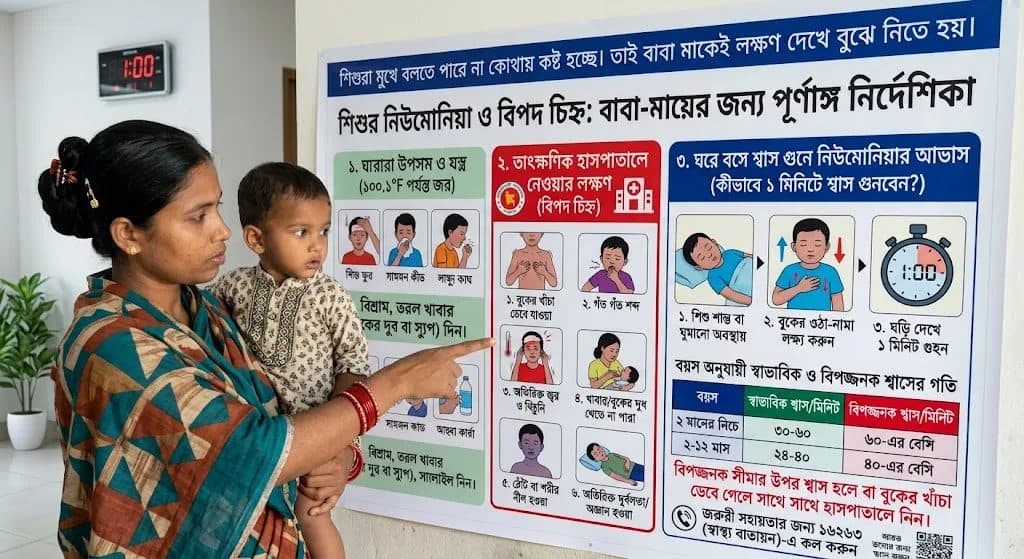
When a child falls ill, one question dominates a parent's mind. Is this just an ordinary cold and fever, or is it something serious?
The question is hard because a young child cannot say where it hurts. That leads to two kinds of mistakes. Some parents panic at a mild runny nose and start antibiotics, while others see a genuine danger sign and tell themselves the child has simply caught a chill.
The good news is that medicine has identified a specific set of signs that parents can check at home. In the World Health Organization's guidance for managing childhood illness, these are called danger signs.
This article is about those signs.
Why this matters
According to the World Health Organization, pneumonia and diarrhoea are among the leading causes of death in children under five, and nearly all of these causes are preventable or treatable.
In the Bangladesh context, UNICEF reports that the country has made considerable progress, with under five mortality falling by 77 percent between 1990 and 2017. Even so, close to one hundred thousand children still die each year, mostly from causes that could have been prevented.
The troubling part is this: more than half of children showing symptoms of pneumonia never receive medical treatment.
The problem, in other words, is not a lack of medicine. It is recognising the signs in time.
Signs that mean going to hospital immediately
WHO guidance treats the following as general danger signs. If any one of them appears, the child needs urgent medical care.
The child is unable to eat or drink
The child vomits everything that goes in
The child has had a convulsion
Unusual drowsiness, poor response when called, or loss of consciousness
Add to these:
Difficulty breathing
The lower chest wall pulling inward when the child breathes in
A harsh sound from the throat while breathing in
Bluish lips or tongue
At this point, do not wait for a chamber appointment. Go directly to the emergency department of the nearest hospital.
Count your child's breaths at home
This is a simple skill that very few parents know about. The most important early sign of pneumonia is fast breathing, and you can measure it at home.
How to count
The child must be calm and still. Counting while they are crying or running around will not work. Counting while they sleep is ideal.
Watch the rise and fall of the chest or belly and count how many breaths the child takes in one minute. Use a watch or your phone timer.
What counts as fast breathing
WHO guidance sets different thresholds by age.
Child aged less then 2 months: 60 breaths per minute or more
Child aged 2 months to 12 months: 50 breaths per minute or more
Child aged 12 months to 5 years: 40 breaths per minute or more
If the count is above these, see a doctor without delay. It can be a sign of pneumonia.
One more thing to check
Watch whether the lower part of the chest pulls inward as the child breathes in. This is called chest indrawing. If you see it, the situation is more serious and the child needs to go to hospital right away.
What to know about fever
Fever is not a disease in itself. It is the body's response. So instead of reacting to the number on the thermometer, look at the child's overall condition.
See a doctor without delay if:
Any fever in a baby under three months. At this age, fever always means a doctor visit. There is no room to wait
Fever accompanied by any of the danger signs listed above
Fever lasting more than three days
Fever with a stiff neck or severe headache
A rash or spots appearing on the skin
Fever with convulsions
What not to do during fever
Do not bundle the child under heavy clothing or blankets. Heat needs somewhere to escape.
Do not start antibiotics on your own. Most fevers and colds are viral, where antibiotics do not work. Using them unnecessarily creates the risk that they will fail when they are genuinely needed.
Do not break up adult medicine for a child. Dosages for children are calculated by weight, and only a doctor should do that.
The most important thing during diarrhoea
In diarrhoea, the real danger to a child is not the loose stools. It is dehydration.
Signs of dehydration
Sunken eyes
Dry mouth and tongue
No tears when crying
Passing much less urine
Unusual lethargy or extreme irritability
Skin that returns slowly when pinched and released
What to do
Give oral rehydration solution, mixed exactly as instructed. One packet goes into the full amount of water. Mixing it into less water to make it stronger does harm rather than good.
Do not stop feeding the child. Continue breastfeeding.
Do not give anti diarrhoeal medicine on your own.
If there is blood in the stool, repeated vomiting, or any sign of dehydration, see a doctor immediately.
Extra care for newborns
In the first few weeks after birth, a baby's condition can change very quickly. At this age, do not delay if you notice any of the following.
Difficulty feeding or reduced feeding
The body feeling unusually hot or unusually cold
Excessive sleepiness, no movement when called
Any breathing difficulty
Redness, swelling or discharge at the umbilical stump
Yellowing of the skin or eyes, particularly if it reaches the palms and soles
Convulsions
With a newborn, waiting until morning is a risk not worth taking.
Common mistakes
Antibiotics for a mild cough or cold. Buying them over the counter harms the child in the long run.
Skipping or delaying vaccines. Pneumonia and several other serious illnesses are preventable through vaccination. Follow the EPI schedule.
Not tracking weight gain. A child failing to gain weight properly is often the first signal of an underlying problem.
Stopping medicine once symptoms improve. Complete the course exactly as the doctor prescribed.
Losing time on home remedies. Once a danger sign appears, there is no substitute for going to hospital.
Which doctor should you see
Pediatrician is the first stop for any childhood illness, routine check ups, vaccination and nutrition advice.
Neonatologist for complications in the first month of life, and for babies born premature or with low birth weight.
Emergency department immediately, if any of the danger signs above appear.
Avoid taking a child to a doctor who treats adults, or giving them adult medicine. A child's body works on entirely different parameters.
On DoctorsFindBD you can search by area and specialty, with chamber addresses and visiting hours in one place.
A final word
In a child's illness, parents hold the biggest advantage, because they are the first to sense that something is not right.
Memorise the danger signs above, or save this article. When the moment comes, this much information is enough.
And the simplest rule of all: if in doubt, see a doctor. Being wrong is far better than being late.
References
World Health Organization (WHO) Integrated Management of Childhood Illness (IMCI) Chart Booklet: cdn.who.int
World Health Organization (WHO) Child mortality (under 5 years) fact sheet: who.int
UNICEF Bangladesh Report on childhood pneumonia: unicef.org
WHO IMCI Respiratory Illness Clinical Guidelines, breathing rate thresholds: ncbi.nlm.nih.gov