


Heart Attack Warning Signs: The Symptoms You Must Never Wait On
A heart attack does not always look like someone collapsing while clutching their chest. Most begin slowly with mild discomfort that people mistake for indigestion. Learn the warning signs and exactly what to do in that moment.
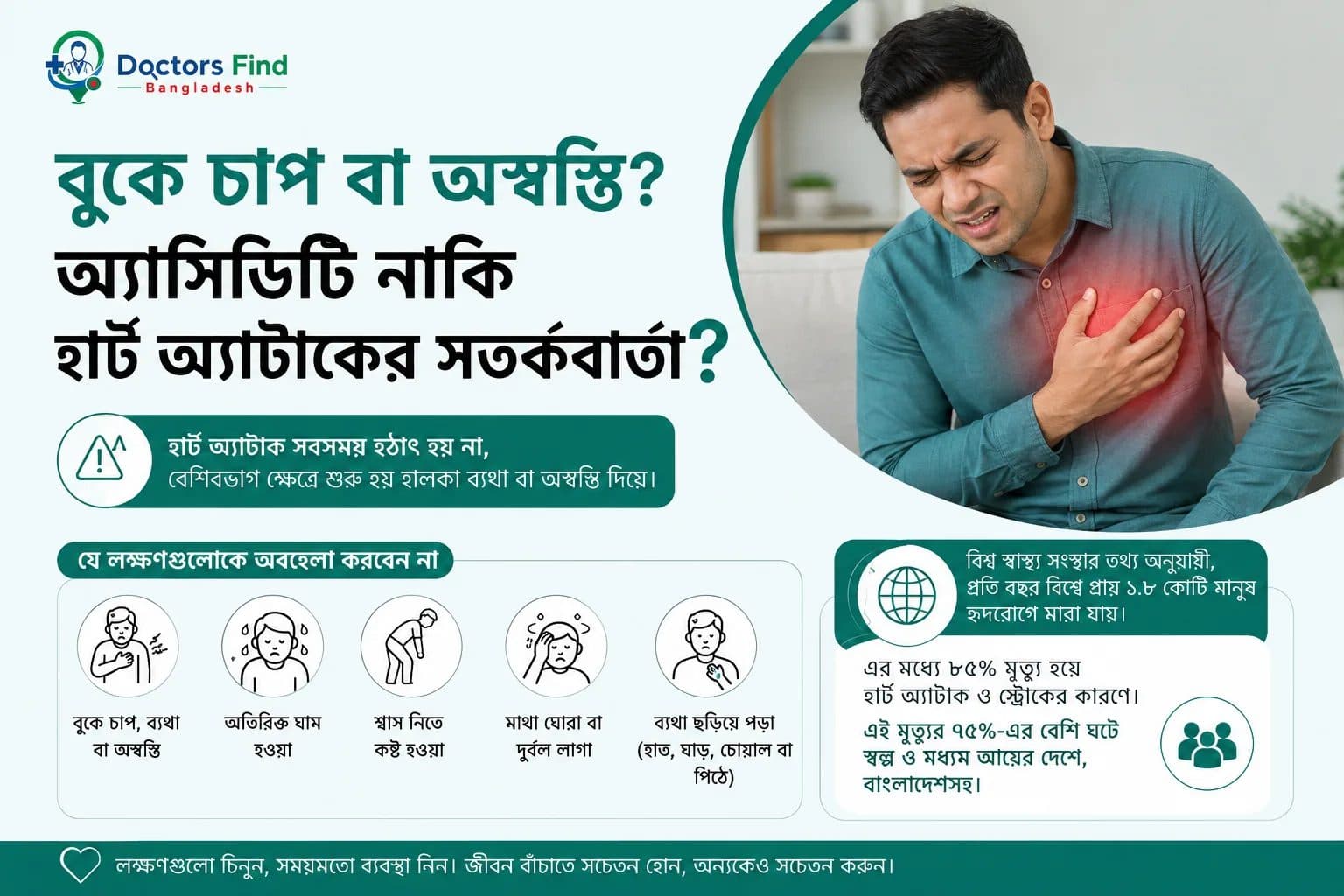
There is a pressure in the chest, a bit of discomfort. Most people reach the same conclusion first: it must be indigestion. They take an antacid and lie down.
That decision sometimes turns out to be the most expensive one of their life.
The biggest misconception about heart attacks is that they arrive suddenly and dramatically. The reality is different. According to the American Heart Association, while some heart attacks are sudden and intense, most start slowly with mild pain or discomfort.
It also helps to understand the scale of the problem. The World Health Organization estimates that around 19.8 million people die from cardiovascular diseases each year, roughly 32 percent of all deaths worldwide, and 85 percent of those deaths are due to heart attacks and strokes. What matters for us is where those deaths happen: more than three quarters occur in low and middle income countries, Bangladesh among them.
So recognising the warning signs is not only for the patient. It matters for everyone in the household.
What a heart attack actually is
The heart is a muscle, and like every muscle it needs blood. The coronary arteries supply it.
Over years, fatty deposits build up along the inner walls of these arteries and narrow them. At some point a clot forms and the blood supply stops completely.
The part of the heart muscle that is cut off begins to die. That is a heart attack.
The time factor is what people underestimate. The longer blood flow stays blocked, the greater and the more permanent the damage to the heart muscle. This is exactly why the wait and see approach is so dangerous here.
The main warning signs
Chest discomfort
The most common sign. Pressure, heaviness, squeezing or a burning sensation in the centre or on the left side of the chest.
Two features are worth noting:
It lasts more than a few minutes
Or it goes away and then comes back
Many people expect a sharp, stabbing pain. In practice, most patients describe it as something heavy pressing down on the chest.
Pain in the upper body
The discomfort does not stay in the chest alone. It can spread to:
One or both arms, particularly the left
The shoulders
The neck
The jaw
The back
The upper abdomen
Jaw or back pain is often mistaken for a dental problem or a pulled muscle.
Shortness of breath
This can happen with or without chest discomfort. Getting winded from light activity, or struggling to breathe even while resting.
Other signs
Breaking out in a cold sweat
Nausea or vomiting
Dizziness or lightheadedness
Unusual fatigue
Palpitations
A sudden sense of unexplained anxiety
Why women need extra vigilance
For women too, the most common symptom is chest pain or discomfort. But the American Heart Association notes that women more often experience symptoms that are not typically associated with a heart attack.
Shortness of breath
Nausea or vomiting
Back, shoulder or jaw pain
Unusual fatigue
Because these symptoms are vague, they get dismissed as indigestion, general weakness or simply ageing. The result is a delayed arrival at hospital.
In our culture, women are also more likely to downplay their own discomfort. Family members need to pay particular attention here.
Not every heart attack causes pain
A difficult truth: some heart attacks happen silently. The US Centers for Disease Control and Prevention estimates that about one in five heart attacks is silent, meaning the damage occurs but the person is unaware of it.
This is more common in people with diabetes, since long standing diabetes can damage nerves and blunt the sensation of pain.
If you have diabetes, high blood pressure or kidney disease, do not brush off mild chest discomfort or unexplained weakness.
What to do if you suspect a heart attack
Do this
1. Get emergency help without delay. The national emergency number in Bangladesh is 999. Get the person to the nearest hospital by ambulance or the fastest available transport.
2. Choose a hospital with an emergency department and cardiac facilities. Do not travel far in search of the best hospital. Arriving quickly comes first.
3. Keep the person seated or half reclined. Loosen tight clothing and make sure there is air circulation.
4. Stay with them. Watch for any change in their condition.
5. If a doctor has already prescribed heart medication and explained when to take it, follow those specific instructions.
Do not do this
Do not drive yourself to the hospital. If your condition worsens on the way, the consequences can be severe. Have someone else take you.
Do not take or give any medicine on your own. Borrowing a relative's heart medication is dangerous. Let a doctor or emergency responder decide what is safe.
Do not tell yourself you will wait and see if it eases. Being sent home after a false alarm is far better than arriving too late.
Do not relax simply because the pain went away. Even if symptoms subside, see a doctor.
What raises your risk
Some risks are outside your control, such as age and a family history of heart disease.
But the World Health Organization points out that most cardiovascular disease is preventable, because its main drivers are behavioural and environmental:
Tobacco use and smoking
An unhealthy diet, especially excess salt, sugar and fat
Physical inactivity
Excess weight
Harmful use of alcohol
Air pollution
These show up in the body as raised blood pressure, raised blood sugar and raised blood lipids.
What to get checked regularly
The most dangerous feature of cardiovascular disease is that the underlying problem in the blood vessels often produces no symptoms at all. As the WHO puts it, a heart attack or stroke may be the first sign of underlying disease.
That is precisely why routine checks matter. From around the age of 35 to 40, or earlier if heart disease runs in your family, your doctor may advise keeping track of blood pressure, blood sugar and cholesterol.
How often and which tests depends on your age and health status. Your doctor will decide that.
Which doctor should you see
In an emergency there is no time to research specialists. Go straight to the emergency department of the nearest hospital.
For testing and ongoing follow up:
For chest pain, breathlessness or advice on heart risk, see a Cardiologist
For general health checks and management of blood pressure and diabetes, see a Medicine Specialist, who will refer you to a cardiologist if needed
For rehabilitation and long term care after a heart attack, see a Cardiologist
On DoctorsFindBD you can search by area and specialty, with chamber addresses and visiting hours in one place.
A final word
With heart attacks, this knowledge matters in exactly one moment. If you or someone in your family recognises the signs in that moment and gets to a hospital fast, the outcome can be entirely different.
Share this article with your family, especially the older members of your household.
References
World Health Organization (WHO) Cardiovascular diseases (CVDs) fact sheet: who.int
American Heart Association Warning Signs of a Heart Attack: heart.org
US CDC About Heart Attack Symptoms, Risk, and Recovery: cdc.gov
US CDC Heart Disease Facts: cdc.gov
World Heart Federation What is Cardiovascular Disease: world-heart-federation.org