


Fever With Severe Joint Pain: Is It Dengue or Chikungunya?
Chikungunya cases rise in Bangladesh after the monsoon. The symptoms resemble dengue, but the two are not managed the same way, and self-medicating can be dangerous. How they differ, what to do, and what happens when the joint pain lingers for months.
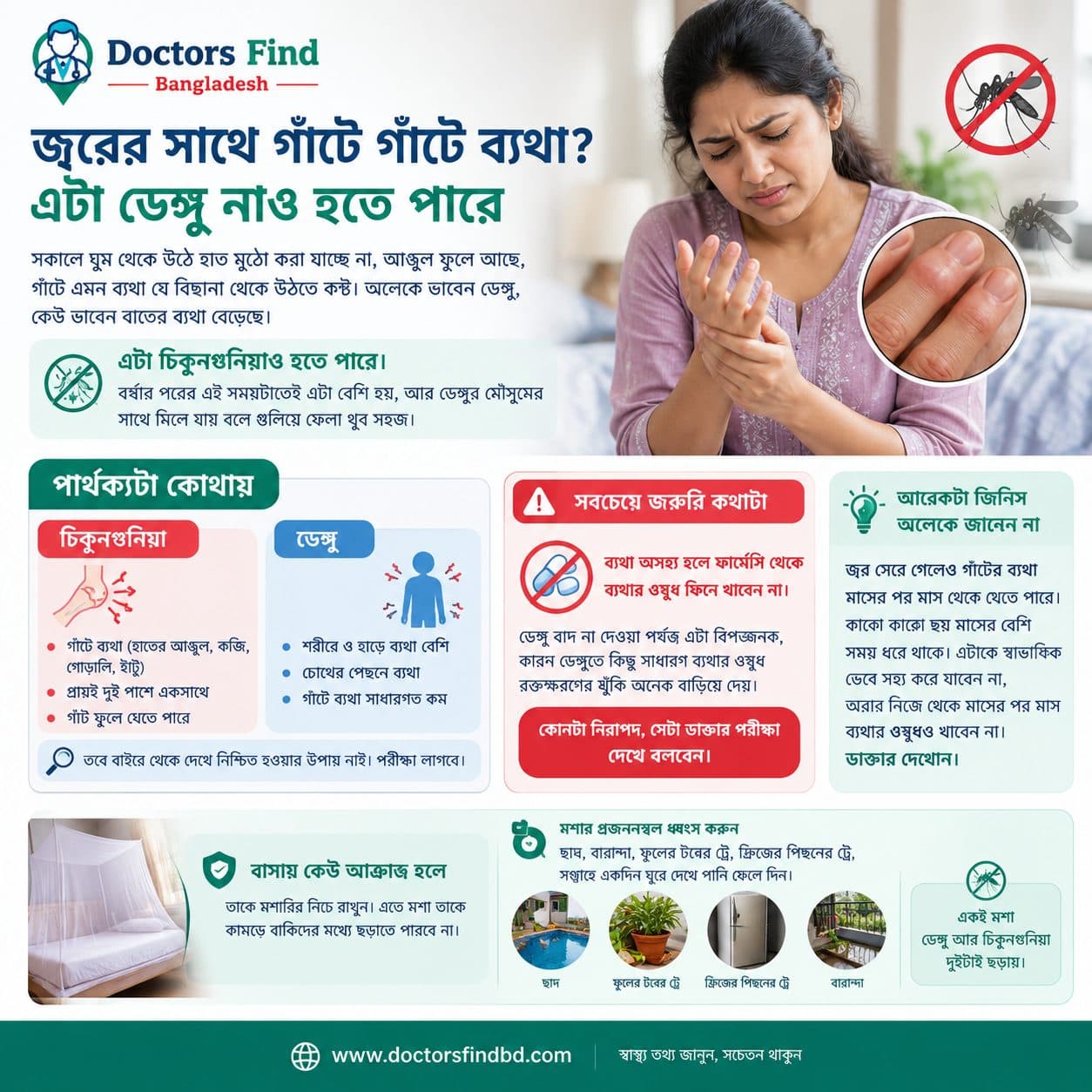
The fever has come on, and with it joint pain severe enough to make getting out of bed difficult. The fingers are swollen. In the morning you cannot close your hand into a fist.
Most people assume dengue first. Some assume their arthritis has flared up.
Either could be true. But it could also be chikungunya.
In Bangladesh, chikungunya transmission tends to peak in the months after the monsoon, overlapping closely with the dengue season. The symptoms overlap too. Confusing the two is easy.
And confusing them is risky, because the two are not managed the same way.
What chikungunya is
It is a viral illness spread by the bite of the Aedes mosquito, the same mosquito that spreads dengue. That is why the two diseases so often appear in the same place at the same time.
The name comes from an African word meaning roughly "to become contorted," a reference to the stooped posture of patients doubled over in pain.
It is not new to Bangladesh. Cases have been recorded since 2008, and a large outbreak hit Dhaka in 2017.
One complication is that chikungunya is not part of routine national disease surveillance, and testing is not widely available outside major centres. The actual number of cases is believed to be considerably higher than what gets reported.
Symptoms
Symptoms usually begin 4 to 8 days after the mosquito bite.
The two main symptoms
Sudden onset of high fever
Severe joint pain
Research indicates that more than 95 percent of confirmed symptomatic patients experience both.
Often accompanied by
Muscle pain
Headache
Joint swelling
Rash
Nausea
Unusual fatigue
How dengue and chikungunya differ
Only a blood test can confirm which it is. Still, some general differences are worth knowing.
The nature of the pain. In chikungunya, pain centres on the joints, especially fingers, wrists, ankles and knees. It often affects both sides of the body at once, and the joints may swell. Dengue pain is felt more in the body, bones and muscles.
Pain behind the eyes is a more characteristic dengue symptom.
Bleeding risk is higher in dengue. It is comparatively uncommon in chikungunya.
Risk of death is low in chikungunya, though complications are more likely in the elderly, newborns and people with diabetes or heart disease.
How long the pain lasts is where chikungunya stands apart. More on that below.
Even so, do not diagnose yourself. A person can have both infections at once. Which test to run and when is for a doctor to decide.
The most important warning
Read this part carefully, because this is where the biggest mistake happens.
When joint pain becomes unbearable, people naturally buy painkillers from a pharmacy.
Until dengue has been ruled out, that is dangerous. In dengue, certain common painkillers substantially increase the risk of bleeding.
Since there is no way to tell the two apart in the early days, keep the rule simple:
Do not take any painkiller on your own during a fever. Let a doctor decide what is safe after examining you and reviewing test results.
Once chikungunya is confirmed, a doctor may well prescribe pain relief. But that is their decision, not yours.
What treatment involves
There is no specific medicine for chikungunya. Nothing kills the virus. The body clears it on its own.
Treatment is therefore about managing symptoms.
Rest
Plenty of fluids: water, coconut water, oral saline
Fever and pain medicine as directed by a doctor
Ask your doctor what to do about swollen joints
The fever usually settles within a few days. The real problem often starts afterwards.
When the pain lasts for months
This is the hardest part of chikungunya, and the part people know least about.
Joint pain can persist long after the fever has gone. Research on cases in Bangladesh found that 25 to 40 percent of patients had pain continuing for more than six months.
Many cannot return to work. Household tasks become difficult. The financial consequences stretch out over months.
What to do in that situation
Do not simply endure long-lasting pain as though it were normal, and do not keep taking painkillers on your own for months. Both cause harm.
See a doctor. Persistent joint pain may need a medicine specialist or, in some cases, a rheumatologist. Physiotherapy or specific exercises can help, but again, on medical advice.
Who faces higher risk
Death from chikungunya is rare. But complications are more likely in some groups.
Newborns, particularly if infected around the time of birth
Older adults, especially over 65
People with diabetes, high blood pressure or heart disease
Pregnant women, particularly close to delivery
For these groups, a fever warrants seeing a doctor without delay.
Prevention is the only real defence
With no specific treatment available, avoiding mosquito bites is the whole strategy. And since the Aedes mosquito also spreads dengue, the same measures cover both.
Around the home
Check your roof, balcony and yard at least once a week for standing water
Empty the trays under flower pots
Clean the drip tray behind the refrigerator and the AC water collection point
Keep water tanks and buckets covered
Clear away discarded tyres, broken containers and coconut shells
Protecting yourself
Use a mosquito net during the day too, since Aedes mosquitoes bite mainly in daylight
Wear clothing that covers arms and legs
Screens on windows and doors help
One more thing. If someone in the household is infected, keep them under a mosquito net. That prevents mosquitoes from biting them and carrying the virus to others. This one simple step protects the rest of the family.
When to see a doctor
If fever lasts more than two days, or comes with severe joint pain, do not delay.
Go to hospital immediately if there is severe abdominal pain, repeated vomiting, bleeding from the nose or gums, difficulty breathing, cold hands and feet, or a sharp drop in urine output. These point to dengue complications, where time is everything.
Which specialist
For adults with fever and joint pain, start with a Medicine Specialist
For children, a Pediatrician
For pain lasting several months, a Medicine Specialist or Rheumatologist
For any sign of complications, go straight to a hospital emergency department
On DoctorsFindBD you can search by area and specialty, with chamber addresses and visiting hours in one place.
A final word
When fever comes with severe joint pain, there is no way to tell from the outside what is causing it. That is precisely why self-diagnosing and self-medicating is risky.
The rule is simple. See a doctor, get tested, and leave the decision about painkillers to them.
And since the same mosquito spreads both diseases, tipping out the standing water around your home remains the most effective prevention there is.
References
World Health Organization (WHO) Chikungunya fact sheet: who.int
US CDC Chikungunya, symptoms and prevention: cdc.gov
Institute of Epidemiology, Disease Control and Research (IEDCR), Bangladesh Chikungunya situation and recommendations: iedcr.gov.bd
Spatiotemporal dynamics and reemergence of chikungunya virus in Bangladesh from 2008 to 2025, on long-term joint pain: pubmed.ncbi.nlm.nih.gov
Tropical Medicine and Health Chikungunya outbreak in Bangladesh (2017), clinical characteristics