


Child Vaccination Schedule in Bangladesh: Which Vaccine, When
Which vaccines a child receives from birth to 15 months under Bangladesh's EPI programme, what each one prevents, what to do if a date is missed, and an easy way to generate your own child's full schedule from their date of birth.
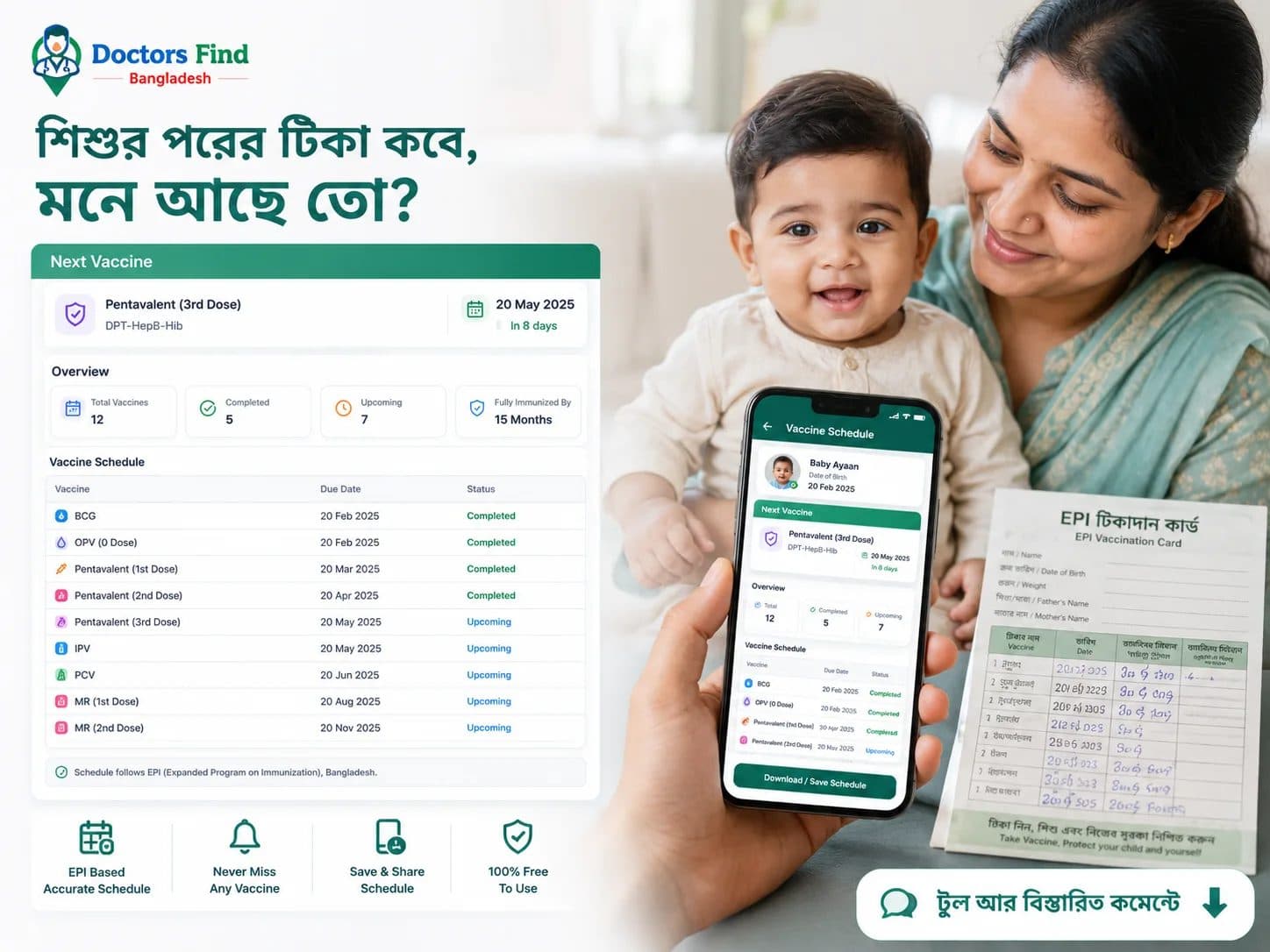
For most parents, childhood vaccination is not a question of belief. Almost everyone knows the vaccines need to be given. The hard part is remembering.
The card gets tucked away somewhere and forgotten. The next date slips the mind. Or you remember it falls sometime this month but not which day. That is how one dose gets delayed, then another, and occasionally one gets missed entirely.
Yet the vaccines given in a child's first eighteen months protect against more than ten serious diseases. Several of them have no specific cure at all. Prevention is the only option.
This article lays out the full schedule in one place, along with a simple way to stop doing the calculation yourself.
Bangladesh's EPI programme
Children in Bangladesh are vaccinated under the Expanded Programme on Immunization, or EPI. Launched in 1979, it is among the most successful public health initiatives the country has run.
The results speak for themselves. Bangladesh was certified polio free in 2014, and eliminated maternal and neonatal tetanus in 2008.
Two things are worth knowing upfront:
Vaccines are completely free. There is no charge at government hospitals, upazila health complexes, community clinics or designated EPI centres.
Multiple vaccines can be given on the same day. They are administered at different sites on the body and this is entirely safe. Parents who insist on spacing them out one by one end up disrupting the whole schedule.
The full schedule
At birth
BCG, one dose. Protects against tuberculosis.
Best given as soon as possible after birth. It goes into the upper left arm and leaves a small scar, which serves as proof the vaccine was given.
At 6 weeks
Pentavalent, 1st dose
OPV (oral polio), 1st dose
PCV, 1st dose
fIPV (injectable polio), 1st dose
Pentavalent covers five diseases in a single vaccine: diphtheria, tetanus, whooping cough, hepatitis B, and Haemophilus influenzae type b.
PCV protects against pneumococcal pneumonia, one of the leading causes of child death.
At 10 weeks
Pentavalent, 2nd dose
OPV, 2nd dose
PCV, 2nd dose
At 14 weeks
Pentavalent, 3rd dose
OPV, 3rd dose
PCV, 3rd dose
fIPV, 2nd dose
This completes the main primary series.
At 9 months
MR, 1st dose. Protects against measles and rubella.
At 15 months
MR, 2nd dose.
This second dose is the one most often skipped. The child is older by then and parents assume the job is done. In reality, the first dose alone does not provide full protection. The second matters just as much.
Why the second measles dose cannot be skipped
This deserves its own section, because Bangladesh saw a measles outbreak in 2026, with child deaths reported.
Measles is not simply a rash. It can lead to pneumonia, diarrhoea, and even inflammation of the brain. For undernourished children the risk is higher still.
It also spreads extremely easily. One infected child can pass it rapidly to unvaccinated children around them.
So make sure both doses happen, at 9 months and at 15 months.
What if a date is missed
Some parents worry far more than necessary about this. Others conclude the opposite, that once the date has passed there is no point.
Both are wrong.
If a date has passed, go to the EPI centre as soon as you can. You do not start over from the beginning. You continue from where you stopped.
A delayed second dose does not mean repeating the first. The remaining doses are simply given following the proper intervals.
Still, do not delay by choice. As long as the course is incomplete, the child remains at risk.
If the card is lost or you cannot remember which doses were given, tell the EPI centre. Their register holds the record.
Fever after vaccination
Mild fever, soreness, swelling or redness at the injection site, or a fussy child, are all normal after vaccination. They are signs the body is building immunity, and usually settle within a day or two.
What to do
Offer plenty of breast milk or fluids. Do not rub the injection site.
Ask the health worker at the time of vaccination whether fever medicine is needed and how much, or consult a doctor. Never break up adult medicine for a child.
When to see a doctor
Very high fever, or fever lasting more than two days
Convulsions
Unusual drowsiness or poor response when called
Difficulty breathing
Significant swelling or discharge at the injection site
The child unable to feed
Misconceptions that persist
"My child is unwell, so we'll skip today." A mild cold, cough or slight fever usually does not prevent vaccination. If unsure, go to the centre and let the health worker decide. Do not skip on your own.
"That many vaccines in one day is too much for a baby." Giving multiple vaccines together is safe. They are administered at separate sites.
"Private clinic vaccines are better." EPI vaccines are the same quality, and free.
"Vaccines make children weak." There is no basis for this.
"We didn't have all these vaccines and we survived." The diseases that feel rare today are rare precisely because of these vaccines.
Look after the EPI card
The card is more than a vaccination record. It can be needed for school admission, passports, and future medical care.
One simple habit helps: photograph both sides of the card and save it on your phone. Even if the card is lost, the information survives.
Generate your own child's schedule
The list above is general. But working out exactly which date 6 weeks falls on for your child, when 14 weeks lands, or which day marks 9 months, is tedious.
We built a free tool to handle that.
Enter your child's date of birth and it produces the exact date for every vaccine according to the EPI schedule. You can see which vaccine comes next, how many are already done, and save the whole schedule as an image on your phone or share it with family.
No cost, no account needed.
Generate your child's vaccination schedule
Where to go, and which doctor to see
For vaccination, go to your nearest EPI centre, community clinic, upazila health complex or government hospital. Vaccines are usually given on set days, so check with your local health worker.
See a Pediatrician if:
Your child was born premature or with low birth weight
Your child has a chronic condition or an immune system problem
There was a severe reaction to a previous vaccine
The schedule has fallen well behind and you are unsure how to catch up
You want to know about vaccines outside EPI, such as rotavirus, chickenpox or influenza
On DoctorsFindBD you can search by area and specialty, with chamber addresses and visiting hours in one place.
A final word
Childhood vaccination is one of those things where delay gains you nothing, and doing it on time protects a child for life.
Enter the date of birth once, generate the full schedule, and save it to your phone. After that, there is nothing left to remember.
References
World Health Organization (WHO) Expanded Programme on Immunization (EPI) Factsheet, Bangladesh: who.int
Expanded Programme on Immunization (EPI), Directorate General of Health Services (DGHS), Bangladesh National immunization schedule: dghs.gov.bd
Gavi Zero-Dose Learning Hub Bangladesh Childhood Vaccination Schedule: zdlh.gavi.org
World Health Organization (WHO) Integrated Management of Childhood Illness (IMCI) guidance