


You're Vaccinating Your Child, But Are You on Time?
Vaccinating a child is not enough on its own. The age at which each vaccine is given is what makes it work. Why every vaccine has a fixed timing, what delay actually risks, and an easy way to map out the whole schedule from a date of birth.
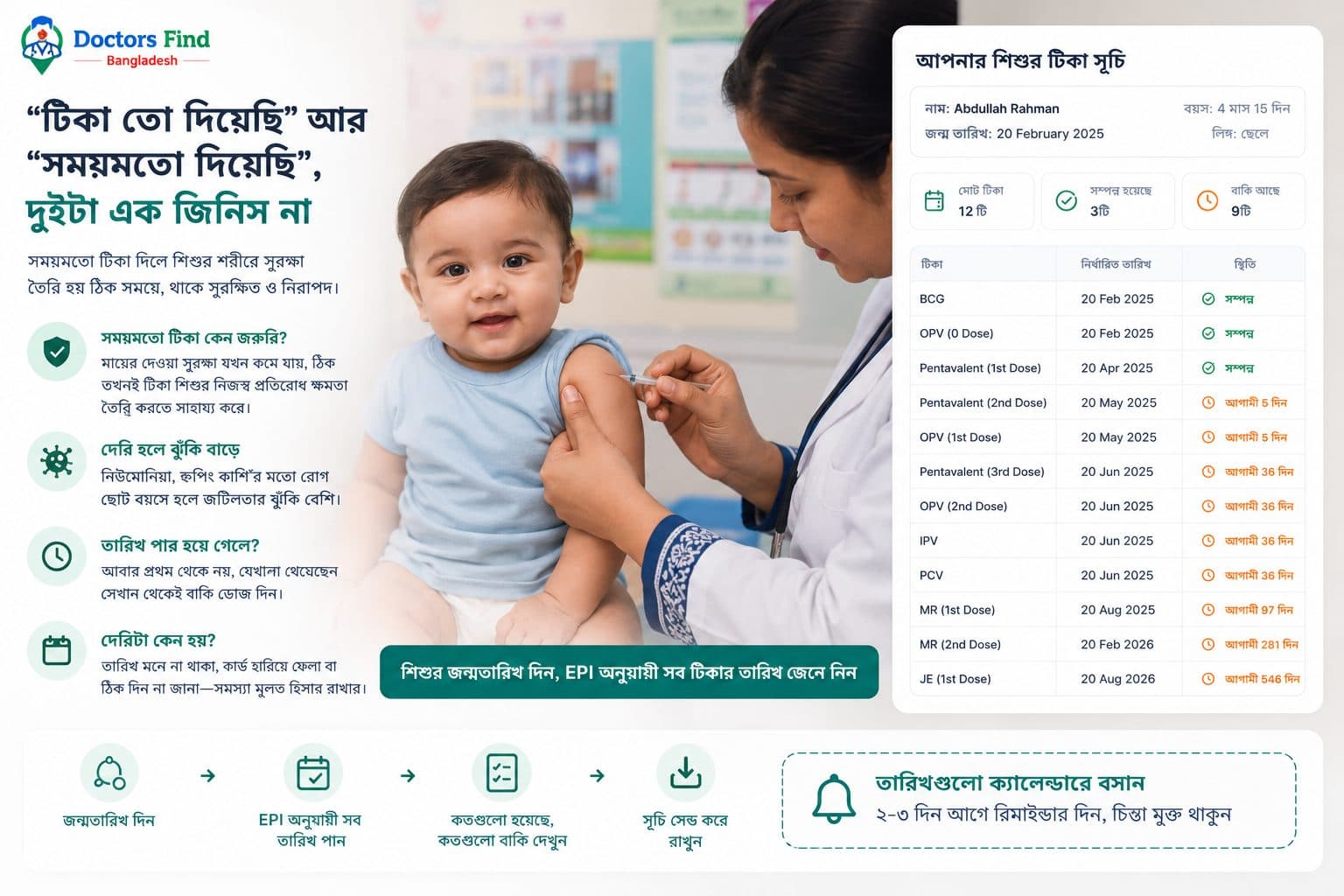
"We've had the vaccines done." Most parents say this with confidence, and there is good reason for it. Vaccination coverage in Bangladesh is high.
But one question gets asked far less often. When did you have them done?
Two weeks late and exactly on time look identical on paper. To a child's body, they are not the same thing.
The vaccination schedule was not put together arbitrarily. Every vaccine has a fixed age attached to it, and there are specific reasons behind each one. This article is about those reasons.
Why each vaccine has a set age
The protection a baby gets from the mother runs out
At birth, a baby receives antibodies from the mother. These offer some protection over the first few months.
But that protection is temporary and fades gradually. The vaccination schedule is built so that a child's own immunity starts developing precisely as the mother's protection is wearing off.
Delay opens a gap in between. That gap is when a child is most exposed.
Protection has to arrive before the period of highest risk
Diseases like pneumonia, whooping cough and Haemophilus influenzae are most dangerous in the youngest children. The younger the child, the higher the risk.
That is why vaccines are given at 6, 10 and 14 weeks, so the body is ready before the most dangerous window opens.
Being three months late means the child was unprotected during exactly those months.
The gaps between doses are calculated too
Vaccines such as Pentavalent and PCV are given in three doses, four weeks apart.
One dose does not produce full protection. Each dose builds on the one before it and strengthens immunity further. The body needs a certain amount of time to do that work, which is why a minimum interval is kept between doses.
Given too close together it does not work properly, and if delayed too long, protection stays incomplete.
What happens when doses are late or missed
The unprotected period gets longer. As long as the course is incomplete, the child stays at risk.
One missed dose leaves protection incomplete. This happens most often with the second measles dose. The child is 15 months old and parents assume the job is finished. In fact, the first dose alone does not give full protection.
One delay drags the rest along. If the 6 week vaccines are given at 9 weeks, the whole series shifts back.
Other children are affected too. Some children cannot be vaccinated because of their age or a medical condition. They stay safe because the children around them are vaccinated. The more children who are vaccinated on time, the less room a disease has to spread.
Why this matters more right now
Bangladesh saw a measles outbreak in 2026, with child deaths reported.
Measles is extremely contagious. It is not merely a rash. It can lead to pneumonia, diarrhoea or inflammation of the brain.
Outbreaks like this usually happen when the number of unvaccinated or partially vaccinated children in an area builds up. Small delays and missed doses accumulate quietly over a few years until they become a number.
Which is why timely vaccination is not only about your own child.
If a date has already passed
One thing needs saying plainly here, because the misconception causes real harm.
Being late does not mean the opportunity is gone.
If a date has passed, get to an EPI centre as soon as you can. You do not start over. The remaining doses are given from where you left off, following the proper intervals.
If the card is lost or you cannot recall which doses were given, tell the centre. Their register holds the record.
In short: being late is a problem, but skipping it because you are late is a much bigger one.
Why delays actually happen
Rarely out of neglect. The reasons are ordinary.
Forgetting the date. Putting the card somewhere and losing track of it. Remembering that it falls this month but not which day. Skipping a week because the child had a mild cold, and then losing track entirely.
The problem, in other words, is record keeping.
And that has a simple fix.
Map out the whole schedule at once
Working out exactly which dates 6 weeks, 10 weeks, 14 weeks, 9 months and 15 months fall on from a date of birth is tedious to do in your head.
There is a free tool on our site for exactly this.
Enter your child's date of birth and it produces the correct date for every vaccine according to the EPI schedule.
What you'll see
The next vaccination date and which vaccines are due that day
Your child's current age
How many of the total stages are complete
The full list from birth to 15 months, including what each vaccine prevents
Which stages have passed and which are still ahead
You can save the whole schedule as an image. Keep it on your phone, or send it to whoever in the family takes the child for vaccination.
No cost, no account needed.
Generate your child's vaccination schedule
One habit worth adding
Once you have the dates, put them in your phone calendar with a reminder two or three days ahead.
And photograph both sides of the vaccination card and save it to your phone. If the card is lost the information survives, and it comes in useful at doctor visits too.
When to consult a pediatrician
For routine vaccination, your nearest EPI centre is enough. But it is worth seeing a pediatrician if:
Your child was born premature or with low birth weight
Your child has a chronic condition or an immune system problem
There was a severe reaction to a previous vaccine
The schedule has fallen well behind and you are unsure how to catch up
You want to know about vaccines outside the EPI programme
On DoctorsFindBD you can search by area and specialty, with chamber addresses and visiting hours in one place.
A final word
With childhood vaccination, there is a real difference between "we had it done" and "we had it done on time."
Enter the date of birth once, generate the schedule, and keep it. After that there is nothing left to remember, and nothing left to fall behind.
References
World Health Organization (WHO) Expanded Programme on Immunization (EPI) Factsheet, Bangladesh: who.int
Expanded Programme on Immunization (EPI), Directorate General of Health Services (DGHS), Bangladesh National immunization schedule: dghs.gov.bd
Gavi Zero-Dose Learning Hub Bangladesh Childhood Vaccination Schedule: zdlh.gavi.org
World Health Organization (WHO) Child mortality (under 5 years) fact sheet: who.int